




A demo account can be both a binary options trader's best friend and their worst enemy. It all depends on how you use it. For beginners, it often gives the illusion of easy money, lulls them into complacency, and fosters bad habits that almost certainly lead to losing your deposit on a real account.

If you want your first real binary options trades to be profitable rather than disappointing, you need to know the rules of the game. In this review, we'll explain why demo trading can be deceptive and provide a step-by-step plan to help you avoid pitfalls and protect your first deposit.
Content:
- How a Demo Account Distorts Your Perception of Risk and Leads to Failure
- What brokers don't show on a demo account?
- A step-by-step guide to safely transitioning from a demo to a live account
- Conclusion

How a Demo Account Distorts Your Perception of Risk and Leads to Failure
The main problem with a demo account lies not in the charts and buttons of the trading platform, but in the trader's mind. It creates a dangerous illusion that inevitably shatters reality as soon as real money is involved. This distorted risk perception among many binary options traders arises for several interrelated reasons.
First, demo trading involves virtually no emotional pressure, because there is no real financial risk. On a real account, every trade evokes a whole range of emotions: from fear of losing money to greed, which pushes you to take unnecessary risks, to intense stress, which makes it difficult to concentrate and think clearly. On a demo account, all these emotions are absent. Therefore, a trader can calmly follow a strategy, knowing they have nothing to lose. This creates a false sense of control and discipline, which instantly disappears as soon as real, significant sums are at stake. 
Secondly, a demo account creates the illusion of free mistakes and complete impunity. If your virtual deposit is lost, no problem: just click the refill button, and trading can resume. This leads to the formation of destructive habits. Traders begin trading aggressively, risking a significant portion of their deposit and completely ignoring the basics of risk and money management. Trades are often opened simply out of boredom or excitement.
These behavior patterns become deeply ingrained in the mind, and when the trader switches to a real account, they continue to act in the same way, which quickly leads to the loss of the deposit.
Finally, a stable profit on a demo account often leads to overestimation of one's skills and the formation of unrealistic expectations. The trader begins to believe they have found the perfect strategy that will always work. Seeing a positive balance, they reason: if they managed to earn 50 percent in a month on a demo account, then the same will happen on a real account. However, the first real drawdown often triggers panic. Instead of calmly continuing to follow the strategy, the trader tries to recoup losses, increases risks, and ultimately quickly loses the entire deposit. The reason is that the psychological pressure of losing real funds is too great, and a demo account is not able to prepare for it.
Thus, while a demo account is a useful training tool, it creates a dangerous psychological environment. It teaches trading without fear or respect for risk, with inflated expectations, which becomes the main cause of failure when switching to a real account.
What Brokers Don't Show on a Demo Account?
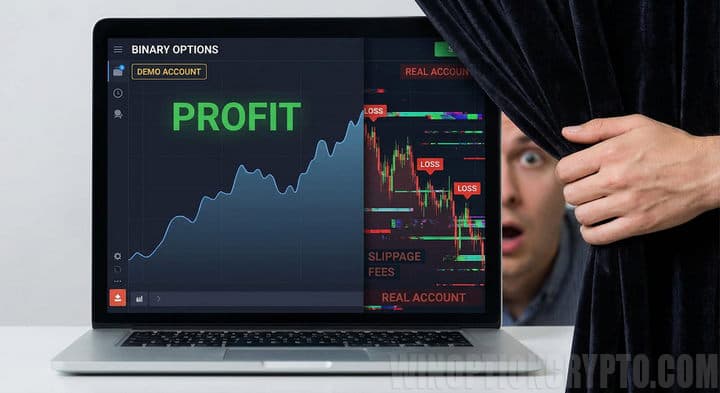
While in traditional trading, various technical nuances can only reduce profits, in binary options, where the outcome of a trade can be decided by literally one point, they can be fatal. A demo account with most binary options brokers is a well-oiled marketing tool that conceals the true market picture.
Ideal Quotes
Many binary options brokers offer a smoother and more predictable demo chart. This allows you to see a clear signal, enter a trade, and the price obediently moves in the desired direction. 
On a real account, quotes are subject to market noise — microscopic price fluctuations, particularly noticeable on shorter timeframes of 1 and 5 minutes. The greatest risk for binary options traders arises at expiration and is associated with potential price manipulation.
An unscrupulous broker can "paint" a candlestick shadow a split second before option expiration, causing a profitable trade to close at a loss. You won't encounter this on a demo account, but in live trading, unfortunately, there may be situations where the broker's quotes momentarily differ from an independent source, such as TradingView.
Instant Execution Without Delays
When you press the Call or Put button in a binary options broker's trading terminal, the trade is opened instantly at the price you see on the screen. This is critical for turbo options, where entering the trade with the exact second is crucial. However, in reality, there is a certain delay, called latency — the time between pressing the button and the trade actually opening on the broker's server.
 In those split seconds, the price can move several pips, especially when trading volatile assets. Eventually, you see a perfect rebound from the support level and click the "Higher" button, but due to the execution delay, the trade opens mid- momentum, at a significantly less favorable price. In such a situation, the chances of a successful outcome are dramatically reduced, as even the slightest pullback takes the binary option you bought out of the money.
On a demo account, such a problem does not exist in principle.
Inflated and Stable Percentage of Payments
For PR purposes, many binary options brokers demonstrate the most attractive payout percentages on demo accounts — 85%, 90%, and even 95%. This payout appears stable across all assets and at all times.

In reality, the payout percentage is typically variable. It can be high during periods of flat trading and low volatility, when market forecasting is difficult. Conversely, as soon as the market begins to trend and clear trading signals for entry appear, the broker sharply reduces payouts for that asset to 55%–65%.
Under these conditions, a strategy that showed a profit on a demo account with a return of 85%, where 54% of profitable trades were enough to break even, instantly becomes unprofitable with a return of 70%, since in this case, 59% of profitable trades are required to break even.
No "Bad" Deals
On the trading platform's demo account, everything works flawlessly: you can open a trade at any moment, even the most volatile. In the real market, especially during important news releases, when price movement becomes  The most predictable problem traders often encounter is that the platform won't allow them to enter a trade. Buttons suddenly become inactive, or after clicking, a message appears: "Trading for this asset is currently unavailable. Please try again later."
This allows the broker to protect itself from large payouts in obvious market situations. As a result, you miss out on the most reliable trade of the day because, unlike on a demo account, in the real market, the broker is essentially playing against you.
As a result, a trader accustomed to the sterile and comfortable conditions of a demo account finds himself completely unprepared for real trading.
A Step-By-Step Guide to Safely Transitioning From a Demo to a Live Account
After all this, it might seem like a demo account is completely useless that should be abandoned. However, this isn't the case. A demo account isn't an enemy, but a powerful tool if you learn how to use it correctly. The problem is that the vast majority of beginners view a demo account as a kind of video game, instead of treating it as a professional training tool.
Before you get behind the wheel of your own car, you learn on a training car, and you're unlikely to immediately start racing into oncoming traffic like characters from the Fast & Furious movies.
First, you need to master parking, smooth starts, and navigating intersections — skills that are truly useful in real life. You should do the same with a demo account.
Your goal is to turn the game into a workout. To do this, follow this step-by-step plan:
- Try to simulate real conditions from the very beginning. Stop treating your demo account deposit as a piece of paper. Top up your demo account not with $10,000, but with the amount you actually plan to use for binary options trading, such as $100 or $200. This will immediately change your attitude toward money.
- Forget about the "Top Up" button. Set a strict rule: if you lose money on your demo account, you don't top it up again, but take at least a week off to analyze your mistakes. This approach teaches you to value your capital and take responsibility for your decisions.
- Trade exclusively according to a clearly defined strategy. Define entry and exit rules in advance. For example, when two moving averages cross and the RSI exits the oversold zone, a call option is opened. Be sure to specify the expiration time and conditions under which you do not trade, such as during news releases with specific events. Your goal at this stage is not to make as much virtual money as possible, but to collect statistics on profitable and losing trades under different market conditions.
- Maintain strict risk management. Risk management is what separates consistent traders from those who constantly lose money. Set a loss limit per trade, for example, 1-2% of your deposit. If your account is $100, your risk per trade should not exceed $1-2. Additionally, set a daily loss limit, for example, 5% of your deposit. If you lose $5, you should stop trading until the next day.
- Keep a trading journal and record every trade on a demo account. This is one of the key learning tools. Record the date and time of the trade, the asset, the reason for entry, the result, and your emotions. Review your entries at the end of each week. This will help you quickly identify recurring mistakes, determine the most favorable conditions for your strategy, and understand which emotions are holding you back the most.
- Set clear goals for switching to a live account. Don't sit on a demo account forever. Otherwise, you'll develop the perpetual-learning syndrome and fear of real trading. Set an achievable goal. For example, switch to a live account after two consecutive months of at least 20% profit on your deposit, or after your statistics show at least 60% winning trades over a period of 100 trades.
Following these steps will allow you to earn virtual money while treating it as real money, and will prepare you to repeat the results in the real market.
Conclusion
A demo account should not be treated as a standalone training tool for binary options traders. Rather, it is a deceptive illusion that deprives beginners of the most important thing — the experience of truly overcoming fear and greed — while simultaneously concealing the technical "surprises" of the real market, such as delays in trade execution and variable payout percentages. Switching to a live account after such "sterile" training, a binary options trader turns out to be not just inexperienced, but a novice with dangerous overconfidence and bad habits. It is this combination, not a lack of knowledge, that most often leads to the loss of a first real deposit.
Therefore, treat a demo account not as a game, but as a testing ground for discipline, risk management, and capital management. Your goal isn't to earn virtual millions, but to become a trader prepared for the psychological pressure and technical difficulties of the real market. Only by following this path can you turn your first real deposit into starting capital for long-term success. To simplify this transition, we recommend opening an account with a broker with a minimum deposit.

To leave a comment, you must register or log in to your account.